 Cardiff Media
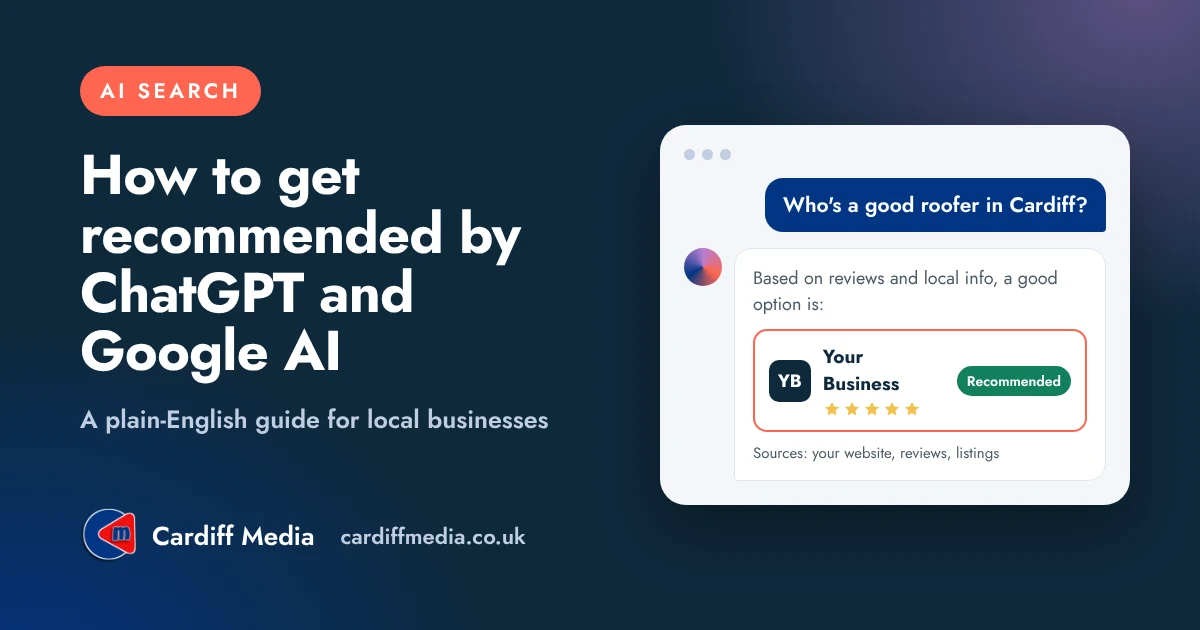
To get recommended by ChatGPT or Google's AI Overviews, make it easy for them to find accurate information about your business and clear proof that you're a credible local option. There's no submission form, special AI tag or paid route to a recommendation. Good local SEO is still the foundation: your website, listings and reviews need to tell the same story, and make it easy for real customers to choose you.
It matters more every month. BrightLocal's 2026 survey found that use of ChatGPT and other AI tools for local recommendations rose from 6% to 45% in a year (BrightLocal). Here's what actually makes a difference, in the order I'd tackle it.
How do AI tools decide which local business to recommend?
AI tools need to understand three things: what you do, where you work, and why a customer should trust you. They draw on your website and on public information such as business listings, reviews and other pages that mention you. The answer can change with the question and with where the person is searching from.
Google says its AI features are built on the same foundations as normal Search, so pages must be crawlable and eligible to appear there. It also says there's no special markup to add and warns against "AEO and GEO hacks" (Google Search Central). ChatGPT's search shows links to the sources it used. Neither promises to recommend any particular business.
So forget trying to trick the AI. Build a business presence that's clear, consistent and useful, and back it with proof.
1. Make your business details match everywhere
Start with the basics. Check that your business name, phone number, website, service area, opening hours and services match on your website, your Google Business Profile and your main listings.
Your Google Business Profile should be complete: the right categories, the services you actually offer, current hours and recent photos. A profile that says one thing while your website says another sends mixed signals to customers and to AI tools.
If you travel to customers, describe your service area honestly. Hide your address if customers don't visit you, never invent premises, and don't claim to cover every town in Wales. Google ranks local businesses on relevance, distance and prominence, and distance is the one you can't change.
2. Answer local questions clearly on your website
Your website should say plainly what you do and where you do it, in the page itself, not only in a footer or a slogan.
Give each core service its own useful page. Location pages are fine when they're genuinely different: the work you do there, real local jobs and the questions customers in that area ask. Copying a Cardiff page and swapping in "Newport" fifty times isn't a local strategy. It's thin content, and Google treats it that way.
Use headings that match real questions, such as "Do you repair leaking roofs in Cardiff?", then answer in the first sentence or two before adding detail. That helps customers scan the page and gives AI tools a clear passage to quote.
Underneath, make sure the pages you want found can be crawled and indexed, link related services together, and add LocalBusiness structured data that matches what people can see on the page. Structured data helps machines read your details. It can't make a vague page or an inaccurate profile trustworthy.
3. Show proof only your business can provide
Generic advice is easy to copy. Real experience isn't. Show the work you actually do: your own project photos, short videos, what's included in each service, named team members and the problems you've solved for customers (with their permission).
Specific results count most. For our clients, that has looked like this:
- Lloyds Fabrications ranks number one in Newport for metal fabrication and gates, on the back of focused service pages and steady reviews.
- Women of a Certain Stage ranks in the top three worldwide for its key searches and appears in Google's AI Overviews.
- MJ Waste Management gained 7 new Google reviews in two weeks after its new site went live, compared with 2 in the three months before.
That kind of evidence is what both customers and AI tools look for. It also has to lead somewhere: a tap-to-call number on mobile, a short enquiry form and a clear explanation of what happens next. If being named in an AI answer doesn't turn into a call, it hasn't helped.
4. Treat reviews as reputation, not a numbers game
Reviews help customers judge risk, and AI tools read them too. BrightLocal found that 97% of consumers read reviews for local businesses (BrightLocal), so what customers say about you quickly becomes what AI says about you.
Ask every genuine customer for honest feedback, and reply professionally to every review, including the critical ones. Don't buy reviews, reward positive ones or ask someone to change a review in return for sorting a problem. Google's review guidance explains how to ask properly, and fake or incentivised reviews now carry legal risk in the UK.
A tool such as RepGro, our own platform, can send the requests and help you reply, but no software can manufacture a good customer experience. Fix recurring problems first, then make it easy for happy customers to say so. Our post on how many reviews a local business needs has a realistic target.
5. Earn genuine mentions beyond your own website
A business is more credible when other reputable places back it up. Keep your main directory listings up to date, and look for real local connections: trade associations, suppliers, community groups, local news and client case studies where a mention makes sense.
Don't chase random links or pay for low-quality directories. A handful of relevant local mentions is worth more than a long list of sites with nothing to do with your trade or area.
And be wary of anyone promising a guaranteed spot in ChatGPT. A good agency explains what it will improve, how it will measure progress and what it can't control. If someone guarantees an AI recommendation, ask them to put the method and the guarantee in writing.
6. Check what your customers actually see
Ask ChatGPT, Google and Gemini the questions your customers would ask, such as:
- "Who can replace a boiler in Cardiff?"
- "Which roofers cover Penarth?"
- "What should I ask before hiring a local electrician?"
Repeat the checks on different days and from different places, because answers vary with the question, the location and the information available. One test doesn't prove you're visible or invisible to everyone.
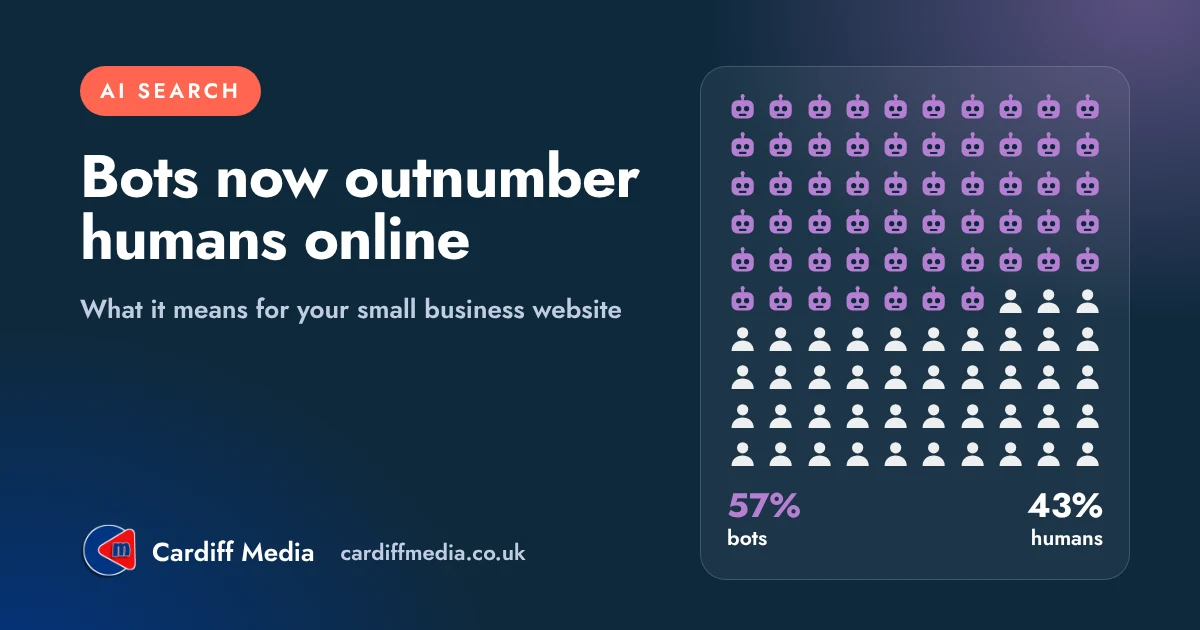
Then track what you can act on: Search Console queries and pages, Google Business Profile calls and website clicks, and the number and quality of enquiries. AI visibility is worth watching, but leads and sales are the point. With bots now making up more than half of web page requests, visitor numbers alone tell you very little (here's why).
What should you fix first?
If you're short on time, work in this order:
- Correct your website and Google Business Profile details so they match.
- Make sure each main service page says what you do and where.
- Add real photos, results and answers to customer questions.
- Set up a steady, honest way to ask every customer for a review.
- Check the site works well on a phone and makes contacting you easy.
- Build a few relevant local mentions, and measure the enquiries they bring.
For the step-by-step version, read our local SEO guide. The businesses AI recommends aren't the ones claiming to have cracked the algorithm. They're the ones that are easy to understand, easy to check and genuinely relevant to the person asking.
Cardiff Media has helped small service businesses get found since 2010. Founder Chris Barnbrook builds fast Cloudflare websites and runs SEO and AI search campaigns for businesses across Cardiff and South Wales. See our SEO services in Cardiff, AI search optimisation or case studies, or book a free site review.
Common questions
Can I pay to be recommended by ChatGPT?
No. There's no paid placement or submission form for ChatGPT's recommendations or Google's AI Overviews. They draw on public information about your business, so accurate details, useful pages and genuine reviews are what count.
Does structured data get my business into AI answers?
Not on its own. Google says there's no special markup needed for its AI features. LocalBusiness structured data helps machines read your details correctly, but it only works alongside clear pages, consistent listings and real reviews.
How long does it take to show up in AI answers?
Fixing your details and pages can be picked up within weeks once they're recrawled. Reviews, mentions and stronger rankings build over months. Most businesses are described more accurately first, then named more often as their reputation grows.