 Cardiff Media
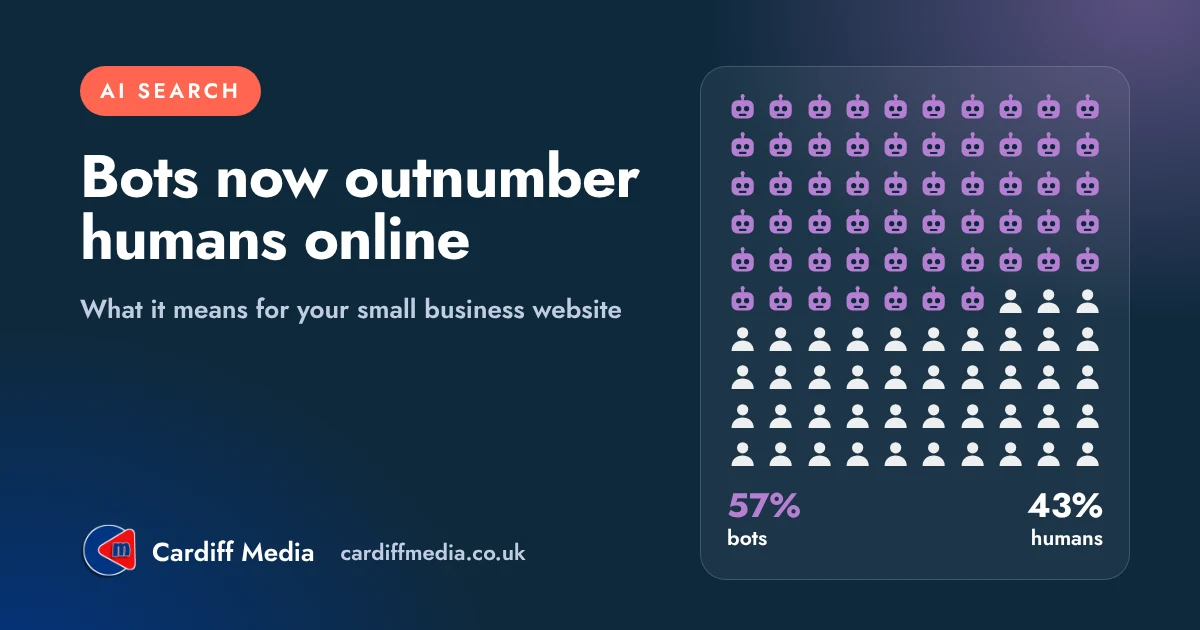
For the first time, machines now request more web pages than people do. Cloudflare reported in June 2026 that bots, including AI tools and agents, made up about 57% of requests for web pages on its network. For a small business, that changes who your website is really talking to, how you should judge your traffic, and what "good SEO" means. It doesn't change the basics.
What the figures actually say
Two statistics have been doing the rounds, and they come from different places.
- 57% of page requests are bots. Cloudflare, which sits in front of roughly a fifth of the world's websites, said automated traffic overtook human traffic for HTML page requests in June 2026, earlier than its CEO had predicted (TechSpot). Counting every request, including images and scripts, people are still the majority.
- AI agent traffic grew 7,851%. This is from HUMAN Security's 2026 benchmark report, not Cloudflare. It measures AI agents that browse, fill in forms and buy things on someone's behalf, which grew from a very small base in 2024 (HUMAN Security). The same report found automated traffic grew around eight times faster than human traffic in 2025.
Most of that agent activity is in retail, travel and media for now. But the direction is clear: more of the visits to your website are software reading, comparing and acting for a person, rather than the person themselves.
1. Your website now has two audiences
Every page you publish is read by people and by machines: Google, Bing, ChatGPT, Gemini, Perplexity and the agents built on them. If a machine can't read your page, it can't recommend you, quote your prices or book a job for someone.
What machines need is not complicated:
- pages that load fast and show their content as plain text, not hidden behind scripts
- your prices, services and areas written on the page in words
- a short, direct answer at the top of each key page
- structured data (schema) that spells out who you are, what you do and where
- the same name, phone number and details everywhere you're listed
The good news is that all of this helps human visitors too. A fast, clear page with real prices converts better whoever is reading it.
2. Check you're not blocking the useful bots
Many hosting and security tools now offer a "block AI bots" switch, and some turn it on by default. It sounds sensible, but it can stop ChatGPT and other AI tools from reading your site, which means they can't recommend you when someone asks for a business like yours.
For a local service business, being named in an AI answer is usually worth far more than the content an AI crawler reads. Block the scrapers and fake traffic, but let the main search and AI crawlers in. If you're not sure what your site allows, ask whoever looks after it, or check your robots.txt file.
3. Get ready for AI agents that book
AI agents are starting to fill in forms and complete bookings for people. HUMAN Security found agents reaching account, login and checkout pages, not just reading product pages. When someone asks an assistant to "book a skip for Friday" or "get me three quotes for a new boiler", the businesses with simple, clear booking and quote forms will be easier to choose.
You don't need to rebuild anything for this yet. Just make sure your prices are visible, your forms are short and clearly labelled, and a customer (or an agent) can get to a booking without hunting for it.
4. Stop judging your website on visitor numbers
If more than half of page requests are machines, raw visitor numbers tell you very little. Some analytics tools filter bots well; others don't. A report showing "20,000 visits" in an area where only a couple of thousand people search for your service each month should make you suspicious, not excited.
Judge your website, and anyone you pay to market it, on the things bots can't fake:
- phone calls and form enquiries
- bookings and quotes requested
- Google Business Profile calls and direction requests
- where you rank for the handful of searches that bring in work
What doesn't change
People still pick up the phone and pay the invoice. Google and its map results are still where most local customers find a business, and Google has said its normal SEO best practices still apply to its AI features (Google Search Central). There's no secret AI trick. A fast site, useful pages, genuine reviews and consistent business details work for people, search engines and AI tools alike.
What to do this month
- Check your site isn't blocking the main AI crawlers.
- Put your prices, services and areas on your pages in plain words.
- Add a short, direct answer to the top of your main service pages.
- Make sure your quote or booking form is short and easy to find.
- Start tracking calls and enquiries, not just visits.
If you'd like to know how your site looks to AI tools, our AI search optimisation page explains what we check, or you can book a free site review.
Common questions
Should I block AI bots from my website?
For most local businesses, no. Blocking the main AI crawlers stops tools like ChatGPT from reading your site, so they can't recommend you. Block scrapers and fake traffic instead, and let the main search and AI crawlers in.
Are bots inflating my website traffic?
Very possibly. Bots now make up more than half of web page requests on Cloudflare's network. Judge your website on calls, enquiries and bookings rather than visitor numbers.
Do I need to change my SEO because of AI agents?
Not fundamentally. The same things that help people and search engines help AI agents: a fast site, clear prices and services, simple forms and consistent business details.